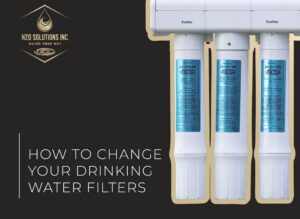
How to Change EcoWater Reverse Osmosis Filters
We recommend changing your reverse osmosis filters regularly to maintain pristine water quality and protect your reverse osmosis system’s health. You might want to set a reminder on your calendar

Share This Post
When considering making a big purchase, such as a water filtration system, you’ll want to make sure you’re well educated. Here are some of the most common water filtration facts and questions:
There are many signs of hard water or water contamination. The Water Quality Association (WQA) states that your water may be contaminated if you experience the following:
However, many contaminants can go under the radar if they don’t have a color, taste, or odor in water. The only way to know for sure if your water is contaminated is to get a water test.
If you’re looking for municipal water reports for your city water in the Inland Northwest, you can find local water reports here.
If you are on city water and live outside of our local area, you can look up your local water quality reports here.
On the condition that you are on well water, you’ll want to regularly test your water yourself. The Centers for Disease Control and Prevention (CDC) found that you should test your water at least once per year for total coliform bacteria, nitrates, total dissolved solids, and pH level.
We offer certified, mail-in SimpleLabs well water testing available for purchase as well.
What you need depends on your water quality. We recommend having your water tested so you can determine what would be best for your home’s needs.
A whole-home system (point-of-entry) will treat the water throughout your whole house, including your showers, sinks, dishwasher, laundry machines, plumbing, etc. These systems increase the lifespan of your appliances, improve hair, skin, and nail health, and more.
An under-sink drinking water system (point-of-use) will filter your drinking water. These typically have a separate faucet (RO faucet) and create an environmentally friendly water solution that filters out any harmful contaminants we consume (such as microplastics, microorganisms, nitrates, arsenic, etc.).
How often you need to change your EcoWater reverse osmosis (RO) filters depends on household water usage. Pre- & post- filters should be changed every 6 – 12 months. The membrane and pH filters last longer and only need to be changed every 36 months or so.
If you’d like to have your filters automatically shipped to you when they’re due, see our filter subscription program. Our goal is to make water filtration more affordable and accessible to everyone.
EcoWater reverse osmosis systems reduce 98.9% of water contaminants.
Here is a list of contaminants our systems filter:
Trichloroethylene
Ethylene dibromide
Pentachlorophenol
1,1,1-Trichloroethane
1,1,2-Trichloroethane
o-Dichlorobenzene
p-Dichlorobenzene
1,2-Dichloroethane
1,1-Dichloroethylene
Tetrachloroethylene
1,2-Dichloropropane
Carbon tetrachloride
Dioxin (2,3,7,8-TCDD)
Total Trihalomethanes
1,2,4-Trichlorobenzene
cis-1,2-Dichloroethylene
Di(2-ethylhexyl) adipate
Di(2-ethylhexyl) phthalate
Polychlorinated biphenyls
trans-1,2-Dichloroethylene
Hexachlorocyclopentadiene
1,2-Dibromo-3-chloropropane
Manganese bacteria
228Benzo(a)pyrene
Heptachlor epoxide
Hexachlorobenzene
Dichloromethane
Methoxychlor
Oxamyl (Vydate)
Haloacetic acids
2,4,5-TP (Silvex)
Cryptosporidium
Chlorobenzene
Giardia lamblia
Total Coliforms
Photon emitters
Photon emitters
Total Coliforms
Vinyl chloride
Ethylbenzene
Sulfur bacteria
Epichlorohydrin
Alpha particles
Beta particles
Atrazine
Uranium
Antimony
Endothall
Asbestos
Beryllium
Cadmium
Chromium
Legionella
Toxaphene
Heptachlor
Acrylamide
Carbofuran
Glyphosate
Radium 226
Acrylamide
Chloramines
Iron bacteria
Vinyl chloride
Ethylbenzene
Microplastics
Chlorine Dioxide
Diquat
Barium
Chlorite
Toluene
Xylenes
Dinoseb
Dalapon
Bromate
Alachlor
Flouride
Chlorine
Simazine
HFPO-DA
Chlordane
Benzene
Styrene
Copper
Arsenic
Radium
Cyanide
PFAS
PFBS
PFHxS
PFNA
PFOA
PFOS
Fluoride
Mercury
Nitrate
Nitrite
EcoWater whole-house water systems are designed to fit in any room, corner, or closet. See our gallery of installs for examples.
If you have low water pressure from your RO faucet, there could be a number of things wrong. The most common issue is needing a filter change:
The best way to remove microplastics from your water is to get a reverse osmosis (RO) under-sink drinking water system.
If you’re a homeowner in the Inland Northwest, we offer complimentary in-home water testing. If you’re ordering mail-in water tests, make sure they are certified. You can order certified mail-in water tests here.
Pros of water softeners:
Cons of water softening
How much water filtration costs depends on what you’re filtering, the type of system that’s best suited for your household needs, budget, and more. We offer complimentary quoting & in-home water testing for the Inland Northwest.
Typically, installing our water treatment systems takes an hour or two. If you’re getting service or having your filters changed, the appointment can take less time.
We service Eastern Washington and Northern Idaho. If you’d like to find out if we service your area, reach out to us.
More To Explore
How to Change EcoWater Reverse Osmosis Filters
We recommend changing your reverse osmosis filters regularly to maintain pristine water quality and protect your reverse osmosis system’s health. You might want to set a reminder on your calendar

Drinking Water Contaminants Found in Post Falls, Idaho by the EPA
The Environmental Protection Agency (EPA) found nine total water contaminants in Post Falls, Idaho. In a report by the Environmental Working Group (EWG), the group found that five of those
Request Your Free Water Analysis Today!