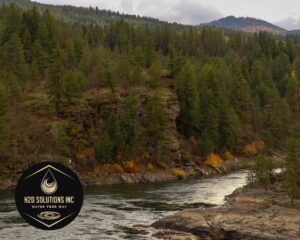
A water quality report for Spokane, Washington, conducted by the Environmental Protection Agency (EPA) and the Environmental Working Group (EWG) in 2024 found 26 total water contaminants in Spokane’s municipal water source. Spokane’s water comes from the Spokane Valley Rathdrum Prairie Aquifer (SVRP). The largest water source for the SVRP is the Spokane River, where most water enters and leaves the SVRP.
Water Contaminants Found in Spokane’s Municipal Water
- Arsenic: 3.19 ppb (EWG Health Guideline: 0.004 ppb)
- Bromodichloromethane: 0.469 ppb (EWG Health Guideline: 0.06 ppb)
- Chromium (hexavalent): 0.260 ppb (EWG Health Guideline: 0.02 ppb)
- Dibromochloromethane: 0.718 ppb (EWG Health Guideline: 0.01 ppb)
- Haloacetic acids (HAA9): 0.557 ppb (EWG Health Guideline: 0.06 ppb)
- Nitrate: 1.72 ppm (EWG Health Guideline: 0.14 ppm)
- Nitrate & Nitrite: 1.23 ppm (EWG Health Guideline: 0.14 ppm)
- Perfluorooctane sulfonate (PFOS): 1.33 ppt (EWG Health Guideline: 0.3 ppt)
- Perfluorooctanoic acid (PFOA): 0.407 ppt (EWG Health Guideline: 0.09 ppt)
- Radium, combined (-226 & 228): 0.16 pCi/L (EWG Health Guideline: 0.05 pCi/L)
- Radon: 398.00 pCi/L (EWG Health Guideline: 1.5 pCi/L)
- Total PFAS & PFOA: 5.05 ppt (EWG Health Guideline: 0.007 ppt)
- Total trihalomethanes (TTHMs): 2.19 ppb (EWG Health Guideline: 0.15 ppb)
- Antimony: 0.473 ppb (EWG Health Guideline: 1 ppb)
- Barium: 19.7 ppb (EWG Health Guideline: 700 ppb)
- Bromoform: 0.355 ppb (EWG Health Guideline: 0.5 ppb)
- Chlorate: 1.31 ppb (EWG Health Guideline: 210 ppb)
- Chlorodifluoromethane: 0.0142 ppb (No EWG Health Guideline)
- Chloroform: 0.227 ppb (EWG Health Guideline: 0.04 ppb)
- Molybdenum: 0.732 ppb (EWG Health Guideline: 40 ppb)
- Perfluorobutane sulfonate (PFBS): 0.733 ppt (EWG Guideline: 2,000 ppt)
- Perfluorohexanoic acid (PFHxA): 0.537 ppt (EWG Health Guideline: 1,000 ppt)
- Perfluoropentanoic acid (PFPeA): 0.572 ppt (EWG Health Guideline: 1,000 ppt)
- PFOS + PFOA + PFHxS + PFNA: 5.05 ppt (No EWG Guideline)
- Strontium: 0.102 ppb (EWG Health Guideline: 1,500 ppb)
- Vanadium: 0.184 ppb (EWG Health Guideline: 21 ppb)
How to Filter Spokane Contaminants
- Arsenic: reverse osmosis and ion exchange
- Bromodichloromethane: activated carbon and reverse osmosis
- Chromium (hexavalent): reverse osmosis and ion exchange
- Dibromochloromethane: activated carbon and reverse osmosis
- Haloacetic acids (HAA9): activated carbon and reverse osmosis
- Nitrate: reverse osmosis and ion exchange
- Nitrate & Nitrite: reverse osmosis and ion exchange
- Perfluorooctane sulfonate (PFOS): activated carbon and reverse osmosis
- Perfluorooctanoic acid (PFOA): activated carbon and reverse osmosis
- Radium, combined (-226 & 228): reverse osmosis and ion exchange
- Radon: activated carbon and reverse osmosis
- Total PFAS & PFOA: activated carbon and reverse osmosis
- Total trihalomethanes (TTHMs): activated carbon and reverse osmosis
- Antimony: reverse osmosis
- Barium: reverse osmosis and ion exchange
- Bromoform: activated carbon and reverse osmosis
- Chloroform: activated carbon and reverse osmosis
- Molybdenum: reverse osmosis and ion exchange
- Perfluorobutane sulfonate (PFBS): activated carbon and reverse osmosis
- Perfluorohexanoic acid (PFHxA): activated carbon and reverse osmosis
- Perfluoropentanoic acid (PFPeA): activated carbon and reverse osmosis
- PFOS + PFOA + PFHxS + PFNA: activated carbon and reverse osmosis
- Strontium: reverse osmosis and ion exchange
- Vanadium: ion exchange
Most effective method of filtration in Spokane: reverse osmosis
How to Get a Water Filter
Depending on whether you have city water or well water, you may have different water contaminants than those listed in Spokane’s municipal water source. To determine the best filtration for you, it is recommended that you have your water tested. If you’re a homeowner in Spokane or the Inland Northwest, you are eligible for a complimentary in-home water test. We, H2O Solutions, also have certified mail-in water tests available for purchase.
SOURCE
Environmental Working Group (EWG) “EWG’s Tap Water Database: What’s in Your Drinking Water?” 2024 https://www.ewg.org/tapwater/
Published on: 1/12/2026
Last updated on: 1/12/2026